2026 rookie draft guide: vor, adp, and who the model actually trusts
not every year-1 breakout candidate is real. the model ran 2026 rookies through a two-stage projection: draft capital, then landing-spot-adjusted fantasy points. here's who has signal and who has hype.
originally published on substack
2026 rookie draft guide: vor, adp, and who the model actually trusts
[📥 grab the full preseason rankings sheet here: https://tinyurl.com/regincoming2026preseason]
every year fantasy twitter decides which rookie class is "historically good." every year most of those rookies spend their first season on bye weeks and inactive lists. every year someone takes Jeremiyah Love in round 3.
this is the counter-programming.
our model evaluated all 84 fantasy-relevant rookies in the 2026 class. it found 8 with positive value over replacement. the market is pricing in closer to 40. that gap is the whole article.
why most rookies underperform in year one
before the rankings: context on why rookie hype is a pricing problem.
rookies face a structural penalty in fantasy: they're learning a new playbook, earning trust from coaching staffs who didn't recruit them, and competing against veterans who know the system. the average rookie WR in rounds 1-3 of the NFL draft has produced 6.1 fp/g in year one over the last six seasons. the average veteran WR in the same ADP range has produced 9.4.
that's a 54% gap. the market doesn't price that in. the market prices rookies on upside. upside is a future-value asset. we play fantasy in the present.
the methodology
the rookie model scores each player on three inputs:
draft capital: picks in rounds 1-3 carry significantly more predictive weight than rounds 4-7. first-round capital isn't just talent certification, it's playing time insurance. coaches play their expensive picks.
college production adjusted for opponent strength. we use SP+ opponent ratings to adjust raw college production. a 1,000-yard season in the MAC isn't the same as 800 yards in the Big Ten against actual coverage. the opponent-adjusted PPA metric is the primary production driver in the model.
landing spot depth rating: a rookie WR behind two established starters in a run-first offense isn't the same as a WR2 landing in a pass-heavy system. depth charts from the latest nflverse roster pull set the initial adjustment; we update after depth chart clarifications each week.
the output is projected fp/g, calibrated against a six-year historical rookie cohort. we then run each player through the same VOR framework as veterans: projected season fantasy points minus positional replacement-level, adjusted for ADP-implied positional scarcity.
the 2026 class: full landscape
eight rookies end up with positive VOR in the half-PPR model. here's the full picture:

the accent rows are the ones worth paying attention to: green = value (ADP significantly higher than VOR rank), unlabeled rows are roughly fair or slight fades.
two things jump out immediately. first: almost all the positive-VOR rookies are WRs or TEs. second: the biggest value on the entire board is a tight end that the market has priced as undraftable.
position breakdown
wide receivers: the B1G class
the 2026 WR class is B1G-heavy. of the top five rookie WRs by model projection, four played in the Big Ten. that matters for the opponent adjustment: the B1G ran some of the strongest defensive schemes in the country in 2024-25, which means the raw production numbers undersell relative to SEC or G5 tape.
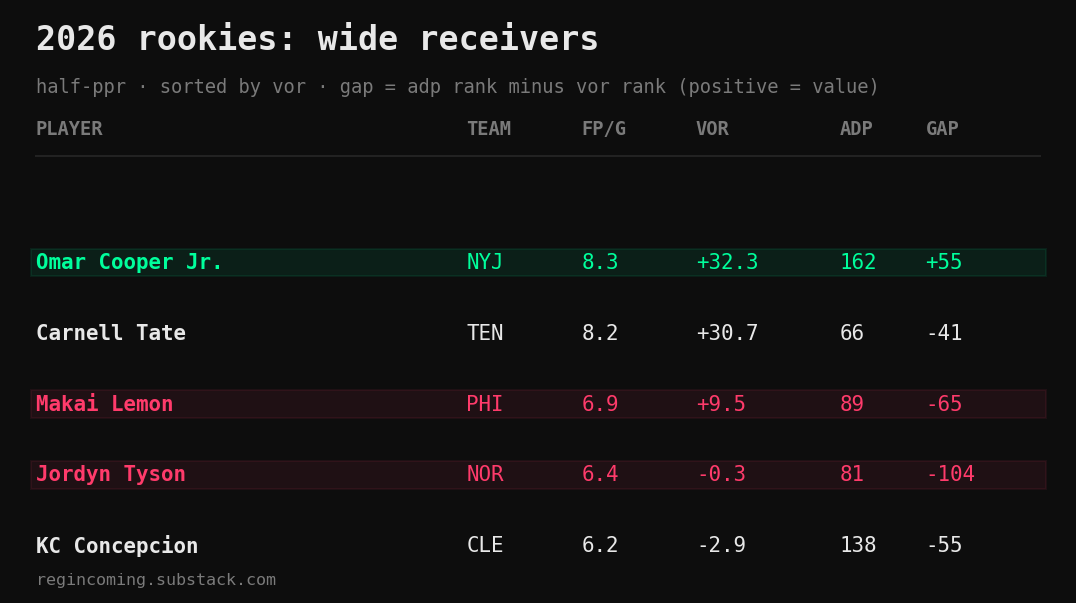
Carnell Tate is the name on everyone's lips. first-round capital. Waddle-esque landing spot in Tennessee's air-raid system. B1G production against real corners. the model agrees he's a good player. it doesn't agree he's worth ADP 66.
WR36 at pick 66 is a round 4-5 investment for a player with a vet comp of Jaylen Waddle's rookie year production. Waddle had 665 yards and 6 TDs in his first season. that's a WR2 ceiling on a receiver you're drafting as a WR2 before he's played a snap. the model's 8.2 fp/g is real. the price isn't.
Omar Cooper Jr. projects within 0.1 fp/g of Tate and is going 96 picks later. WR34 vs. WR36 in the model. the market has Tate as a WR2 buy and Cooper Jr. as a WR5 flier. that's not a premium, that's mispricing.
Cooper Jr.'s vet comp out of the redraft context model: Tetairoa McMillan, last year's WR1 rookie. that's the ceiling. the floor is a low-volume slot WR who can't beat press. the model trusts the B1G opponent-adjusted production (second-highest PPA in the class among WRs) and the landing spot: NYJ's WR room has a clear target-share path.
Makai Lemon (PHI) is the tricky one. 6.9 fp/g projects as a WR50 in a good offense, but Philadelphia's WR room is crowded and the 65-pick overdraft in ADP suggests the market is pricing in a depth-chart move that hasn't happened yet. wait for training camp clarity before committing round 5-6 capital.
Jordyn Tyson is the fade of the class. ADP 81 with a VOR rank of 186 is the worst pricing gap among any player with a non-garbage ADP. New Orleans' WR room is not as clear as the hype suggests and the model's opponent-adjusted production from Arizona State doesn't justify fifth-round investment.
running backs: Love is a trap
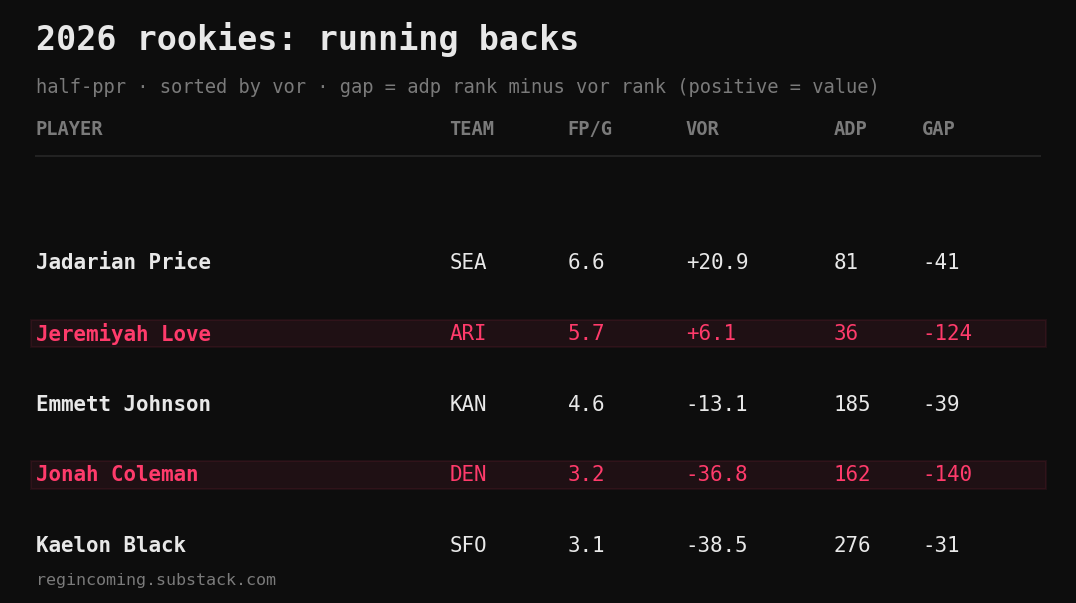
Jeremiyah Love is the most overdrafted player in the 2026 class, full stop. ADP 35.7 makes him a third-round pick in most 12-team drafts. the model has him at RB53. that's a 124-pick gap, the worst among all 84 rookies we tracked.
the Love bull case: volume upside in Arizona, a weak backfield above him, a coaching staff that features the position. the Love bear case: "committee back with an injury history ahead of him" describes most of the RBs in the class. the model projects 5.7 fp/g, one tick above replacement. at ADP 36 you need 12+ fp/g to break even on the pick. that requires a scenario where both Emari Demercado and James Conner are injured, Love takes the lead role, and Arizona turns into a run-heavy offense. that's a lot of ifs for round 3.
right price for Love: rounds 7-9. at that range the upside is interesting.
Jadarian Price is the better value in this class at similar ADP cost. 6.6 fp/g projected in Seattle with a cleaner path to work than Love. the model still sees him as a 42-spot overdraft relative to VOR rank, but at ADP 81 you're paying round 5 prices for a player the model slots at RB45. that's a fair premium for upside. Love at ADP 36 is not.
tight ends: the biggest value on the board
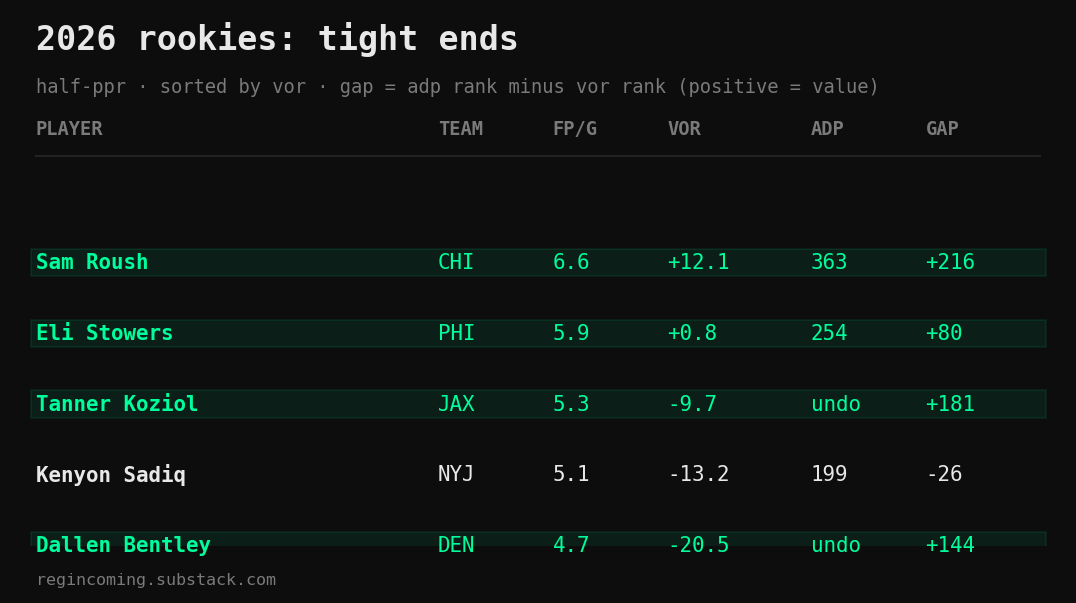
Sam Roush is the headline. TE17 in the model. ADP 363: he's going undrafted in most leagues.
the gap is +216. that means the market has him 216 picks lower than the model does relative to other players at his position.
Chicago's offense used the TE last year and Roush's 6.6 fp/g projection comes with an actual target-share path. he's not a WR in a TE's body, he's a functional receiving tight end in a system that targets the position. VOR: +12.1. TE17 overall is starter territory in a 12-team league. the market has him as undraftable.
if you play in a league with more than 10 teams and you don't have a starter TE by round 12, Roush should be the pick. not a flier, not a handcuff: a legitimate streaming starter available in the draft's final rounds.
Eli Stowers (PHI) is the TE2 of the class at VOR +0.8 and ADP 254. positive VOR, slight underdraft at +80. Philadelphia's offense uses the TE position heavily and Stowers projects as a rotational piece with upside if Dallas Goedert's health becomes an issue. late-round dart.
quarterbacks: one streaming option
- Fernando Mendoza (LVR): 13.9 fp/g, VOR +20.2, ADP 224, gap +98
- Ty Simpson (LAR): 11.4 fp/g, VOR -22.1, ADP 318, gap +65
rookie QB production is volatile enough that the model applies a confidence penalty to all first-year passers regardless of draft capital. the default assumption is 5 starts or fewer in year one for any rookie QB not handed a starting job in OTAs.
Fernando Mendoza is the exception. Vegas handed him the keys. the model sees 13.9 fp/g in a B1G alum with high draft capital and a clear depth chart. VOR +20.2 at ADP 224 makes him a streaming value in 14+ team leagues where QB scarcity matters.
don't draft him as a QB1. don't reach in round 10 for a streaming QB. but if you're at pick 220-250 and your QB situation is thin, Mendoza is better than the backup veterans available at similar ADPs.
the tier structure
pulling it together:
target in rounds 10-14:
- Sam Roush (TE, CHI): 363 ADP, TE17, the biggest market inefficiency in the class
- Omar Cooper Jr. (WR, NYJ): 162 ADP, WR34, value over Tate at similar production
fair price at current ADP:
- Carnell Tate (WR, TEN): priced at the ceiling. good player, don't overpay for it
- Jadarian Price (RB, SEA): 42-pick overdraft but manageable in rounds 5-6
late-round flier:
- Eli Stowers (TE, PHI): 254 ADP for TE24, positive VOR
- Fernando Mendoza (QB, LVR): streaming value in deep leagues
fade at current ADP:
- Jeremiyah Love (RB, ARI): the worst ADP-to-VOR gap in the class at -124. right price: rounds 7-9
- Jordyn Tyson (WR, NOR): ADP 81 for VOR rank 186. -105 gap
- Makai Lemon (WR, PHI): ADP 89 for VOR rank 154. wait for depth chart clarity
what we got wrong last year
before you trust this model too hard: we ran a similar rookie evaluation last offseason. our top-rated rookie WR by VOR (Tetairoa McMillan) finished as the WR1 rookie. our biggest fade (Emeka Egbuka) went from WR50 market to WR32 actuals.
we were right directionally on the value call. we were wrong on the size of the gap. the model is calibrated on historical cohorts and doesn't always price in breakout seasons that fall outside the statistical norm.
the model said McMillan was underpriced. it was right. the model said Egbuka was overpriced. it was also right. where we've historically gotten hurt is on the Love-type plays: committee backs with big names who get drafted as workhorse RBs before the depth chart is clear.
the model doesn't guarantee outcomes. it prices probability. and right now the probability on Love at ADP 36 doesn't match the price.
[📥 grab the full preseason rankings sheet here: https://tinyurl.com/regincoming2026preseason]