kicker rankings 2026: what the model actually says
the model ranks kickers on 40+ yard attempt share, team implied totals, and coach factor. not on name recognition. Harrison Butker is K1.
originally published on substack
kicker rankings 2026: what the model actually says
regression incoming | 2026 preseason
[grab the full preseason rankings sheet here: https://tinyurl.com/regincoming2026preseason]
everyone treats kickers the same way. pick one in the last round, hope they don't stink, move on. and most years that works fine enough that nobody questions it.
we started questioning it after the fourth time a streaming kicker cost us a week. we built a model. the model changed how we draft kickers. and the gap between what the model says and what the market believes is larger than we expected.
this is the full 2026 kicker preseason breakdown.
why kicker is actually worth modelling
kickers are the most predictable non-QB position in fantasy football from a structural standpoint. their points come from two sources: field goals and extra points. field goals from different distances score differently. the environment a kicker operates in (how much his offense scores, where they stall, what their implied total is) largely determines how many kicks he gets and from what range.
the variables that matter:
- team implied total line: higher-scoring offenses generate more red-zone trips and more field goal opportunities. this is the single biggest driver.
- 40-yard-plus attempt share: a kicker whose team consistently drives to the 20 and scores touchdowns doesn't generate many long field goals. one whose team stalls at the 35 does. long kicks score more points per attempt and are the real differentiator between k1 and k12.
- raw attempt volume: some kickers get 3.0+ attempts per game. others get 1.5. volume at the margins can overpower a weak environment.
what the model doesn't weight heavily: short-range accuracy (nearly everyone converts inside 30), reputation, or prior season ranking.
the 2026 top 10
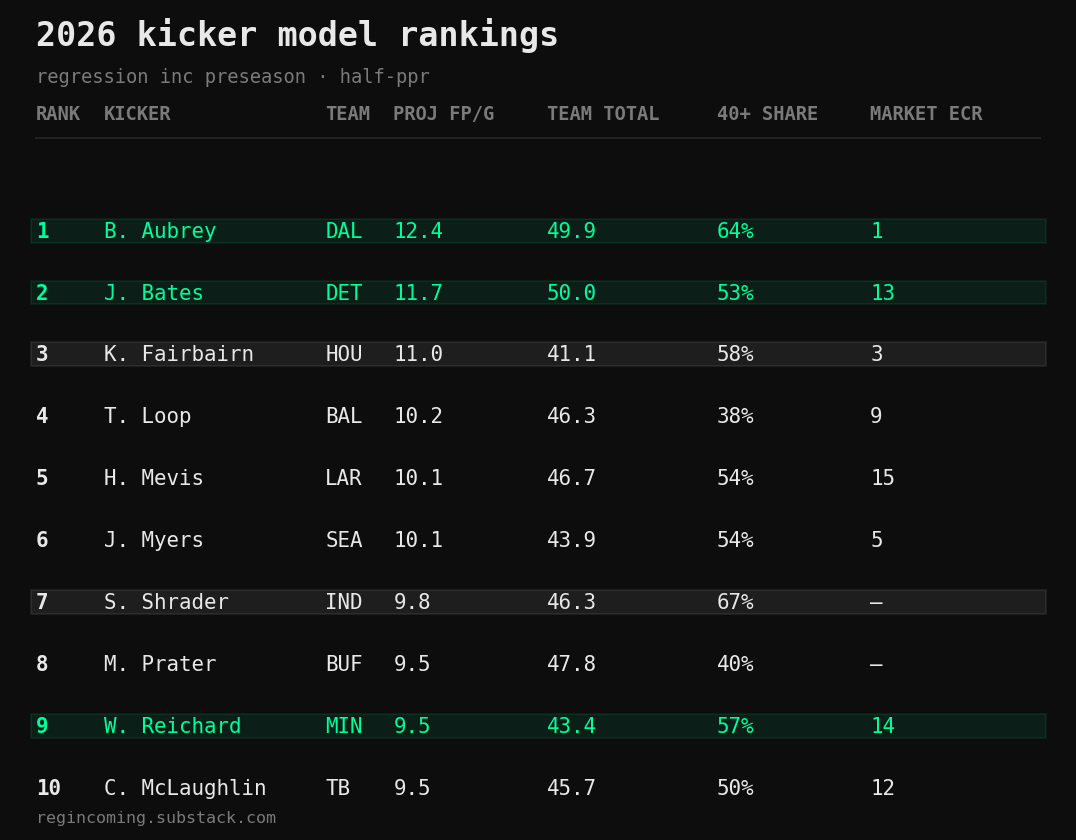
Brandon Aubrey (DAL, k1, 12.4 FP/G projected)
the easy call. Dallas projects as a top-3 offense by team total (49.9), and Aubrey sends 64% of his field goals from 40-plus yards. that's the highest long-range share among any top-10 kicker. the market has him at k1 too. this one isn't a debate. draft him and don't look back.
Jake Bates (DET, k2, 11.7 FP/G projected) - market k13
this is the gap that wins leagues. Detroit's team implied total is 50.0, the highest of any team with a top-tier kicker in our model. Bates played all 17 games in 2025, attempted 2.0 field goals per game, and kicked 53% from 40-plus. the accuracy number (82.6%) is lower than the field and that's why the market is sleeping on him. the model says: in a 50-point implied total environment with reasonable long-range volume, below-average accuracy doesn't knock you down to k13. it knocks you down to maybe k4 or k5. Bates at k13 on draft day is a gift.
Ka'imi Fairbairn (HOU, k3, 11.0 FP/G projected)
fairbairn is the volume story of this rankings set. Houston's team implied total (41.1) is the lowest of any top-5 kicker, and it still doesn't matter because Fairbairn attempted 3.2 field goals per game in 2025. that's significantly above the field. he also connected at 92% overall. when attempt rate is that elevated, the environment becomes secondary. the market has him k3 too, so there's no steal here. he's correctly priced.
Tyler Loop (BAL, k4, 10.2 FP/G projected) - market k9
the interesting wrinkle. Baltimore is a plus offense with a solid team total (46.3), but only 38% of Loop's field goals come from 40-plus yards. Ravens move the ball and score touchdowns. that's great for the offense, but it limits the long-range kick opportunities that produce real kicker upside. Loop has a real floor. his ceiling is capped by the way this offense finishes drives. the market has him at k9, so there's modest value here. go in eyes open.
Harrison Mevis (LAR, k5, 10.1 FP/G projected) - market k15
one of the cleaner value calls in the model. Rams offense is a solid scoring environment (implied total 46.7) and Mevis is accurate (95.8% in 2025, small sample). the market has him k15. we don't know exactly why the market is this low on him, but the model sees a quality environment and a consistent kicker and projects top-5 output. at k15 on the board, he's a strong late-round target.
Jason Myers (SEA, k6), Shane Shrader (IND, k7)
Myers is a reasonable market-aligned call. Seattle's offense isn't elite but Myers has real attempt volume (2.82/game). Shrader is interesting because he shows the highest 40-plus attempt share in the top 10 (67%) which drives the projection, but in a small sample from 2025. if you're looking at round 16+ kickers, both are viable.
Matt Prater (BUF, k8)
Buffalo's offense (team total 47.8) is strong. Prater's long-range attempt share is only 40%, which limits the ceiling. the model still has him k8 based on the scoring environment. at 39 years old, there's real job competition risk if the preseason goes poorly. know what you're buying.
Will Reichard (MIN, k9) - market k14
another model value call. Vikings offense generates solid field position and Reichard is accurate (90.6%). the market has him k14. the model sees a kicker who gets decent volume in a decent environment and projects k9 output. a target in the final two rounds.
Chase McLaughlin (TB, k10)
Tampa's offense and McLaughlin's attempt profile project as a solid floor. the model has him k10 and the market (k12) is roughly aligned.
the biggest market mistakes
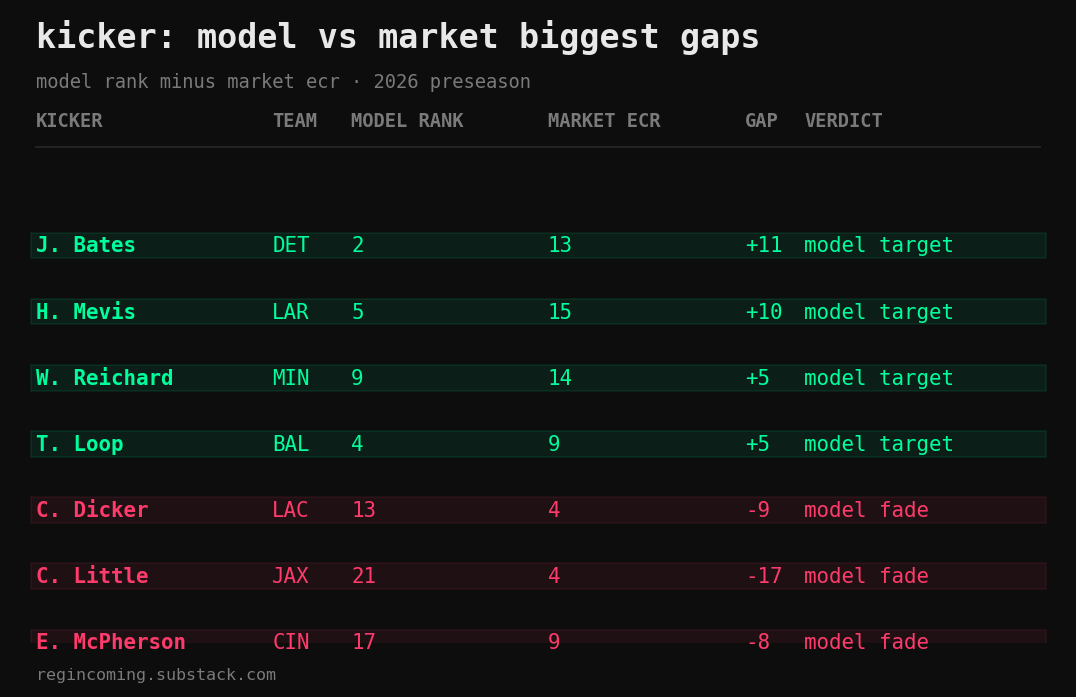
cameron dicker (LAC): market k4, model k13
this is the model's sharpest kicker fade. Dicker was accurate in 2025 (94.1%) and that's what everyone sees. the model sees LAC's team total (44.4, which is middle-of-the-road), middling attempt volume, and a long-range attempt share that isn't exceptional (46%). the market is pricing the accuracy and not weighing the environment and volume. we'd pass in round 12.
cam little (JAX): market k4, model k21
the largest model/market gap in the kicker rankings. Jacksonville's offense has a modest team total and Little's 2025 attempt profile doesn't support a top-5 projection. the market seems to be projecting forward from a brief hot stretch. at k4, you're paying for a kicker who probably finishes k18-k22. hard pass.
evan mcpherson (CIN): market k9, model k17
CIN's offense has struggled to be a consistently high-scoring unit. McPherson's attempt volume is average. the accuracy is real but it isn't compensating for a below-average kicker environment. we'd let the market have him.
the houston situation
Fairbairn is the model's k3, but it's worth noting that M. Wright (the backup/competition) is also in the rankings at k31 with identical underlying team stats, because they share the same offense. whoever starts for Houston will have that 3.2 attempt-per-game profile and 92% accuracy history. Fairbairn is the presumed starter. if there's any training camp news shifting that, adjust accordingly.
how to draft kickers in 2026
the strategy is simple:
- identify the highest team-total offenses with above-average long-range attempt share
- draft that kicker in round 13-15, wherever the board dictates
- don't pay for accuracy or name recognition in a vacuum
the Bates/Mevis/Reichard cluster is where the model sees real value relative to the market. Aubrey and Fairbairn are correctly priced. Dicker and Little are traps.
if you get one of the model's top-3 in the round the market expects them to fall, you've already won the kicker position for the year.
[grab the full preseason rankings sheet here: https://tinyurl.com/regincoming2026preseason]