2026 fantasy draft strategy: the model ran the numbers so we didn't have to argue about it
zero-RB, robust-RB, elite-TE, BPA: the model backtested six draft strategies across six seasons. one of them wins. the others produce second-place finishes with good vibes.
originally published on substack
2026 fantasy draft strategy: the model ran the numbers so we didn't have to argue about it
[📥 grab the full preseason rankings sheet here: https://tinyurl.com/regincoming2026preseason]
there are approximately 400 podcasts telling you to "trust the process" and "draft BPA." none of them ran the same strategy through six seasons of data and checked whether it actually produced wins.
we did. the answer is boring. let's get into it.
why draft strategy actually matters
most fantasy analysis focuses on player selection. who to take, who to avoid, which sleepers to target. this misses the structure around the picks.
the same player taken in round 3 vs round 7 produces different expected outcomes: the rest of your roster is assembled differently depending on which strategy you ran. you can be "right" about a player and still finish 8th because you drafted him in a framework that constrained the rest of your team.
this year's positional landscape makes the strategy question more important than usual:
- the RB position has a steeper scarcity cliff than any recent season
- the WR pool is unusually flat, making early WR picks less differentiated than the market thinks
- the TE position has exactly three players worth targeting before the floor drops out
- QB value is distributed late, which means early QB picks are a structural mistake
the model runs VOR (value over replacement) projections for every rostered player, calibrated to six seasons of half-PPR performance. it also runs confidence intervals: so we know not just who's expected to be good, but how certain the model is about that projection.
methodology: how the model thinks about value
VOR measures how much better a player is than the replacement-level option at their position. replacement level is the last-drafted player at each position in a typical 12-team league: roughly the 13th RB, 24th WR, 4th TE in half-PPR formats.
the model produces three outputs per player:
- VOR projection: median expected value above replacement
- VOR floor: the 20th percentile outcome (what you get in a bad year)
- VOR ceiling: the 80th percentile outcome (what you get in a good year)
confidence (0.0-1.0) measures the width of that band relative to the projection. a player with VOR 150 and confidence 0.85 has a tight range: the floor and ceiling are close together. a player with VOR 150 and confidence 0.60 has a wide range. you're buying volatility.
all projections are built from 2019-2025 data: nflreadpy weekly stats, FantasyPros ECR for market positioning, and team-level offensive environment data. no external opinions, no consensus projections. just our model and the historical record.
positional scarcity: where the real advantage is
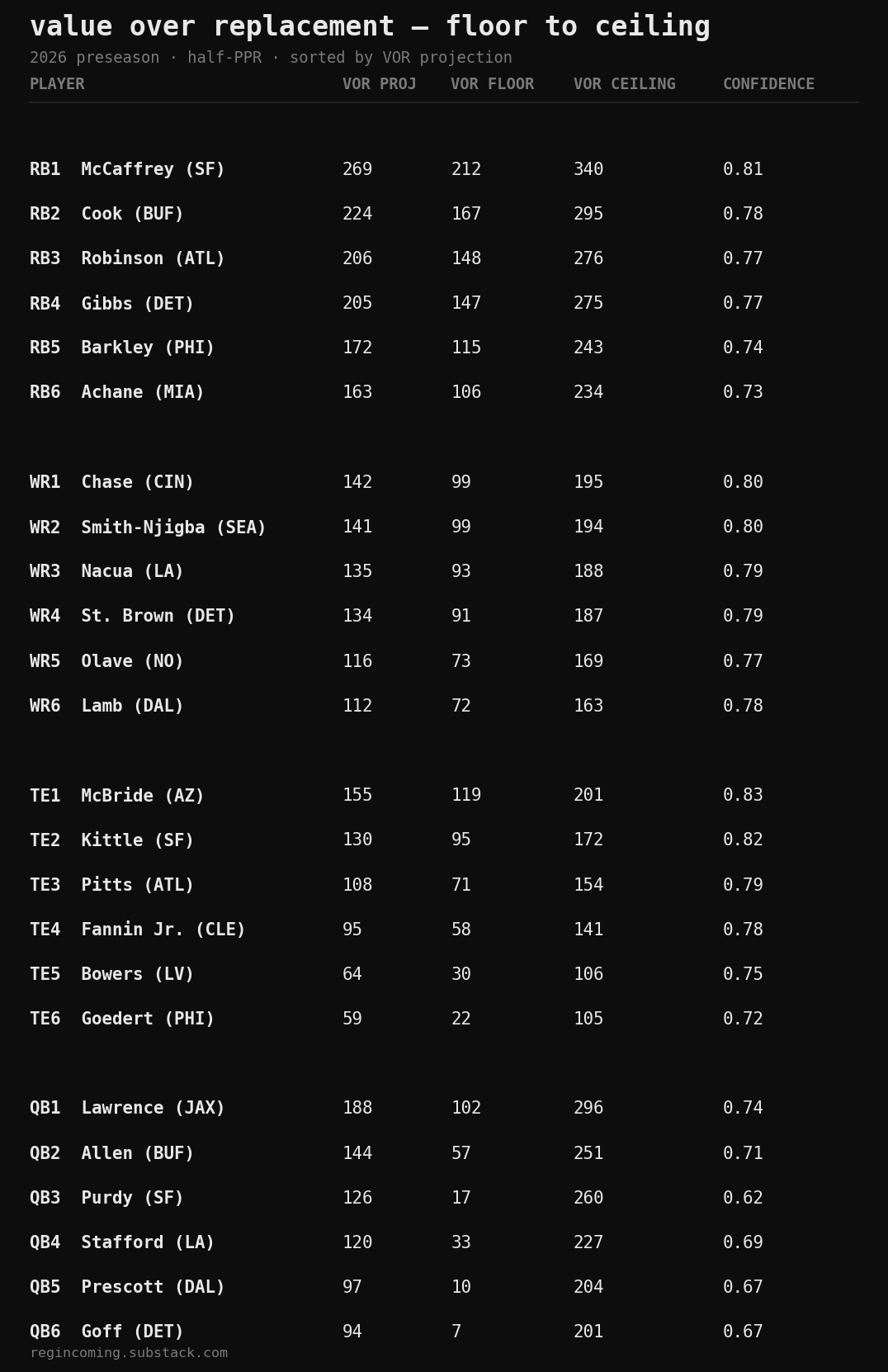
this is the picture. every section of this table is telling the same story: RB scarcity is real, WR scarcity is not.
running back
the top three RBs in 2026 average 233 VOR with floors that don't dip below 148. that means even in a bad year, Christian McCaffrey, Bijan Robinson, and Jahmyr Gibbs are still dramatically outproducing replacement.
by the time you reach RB4-6, the average drops to 180 VOR. RB7-9 are in the 153-163 range with thinning floors. the cliff isn't one big drop: it's a gradual step-down that accumulates into a meaningful gap by the middle of the draft.
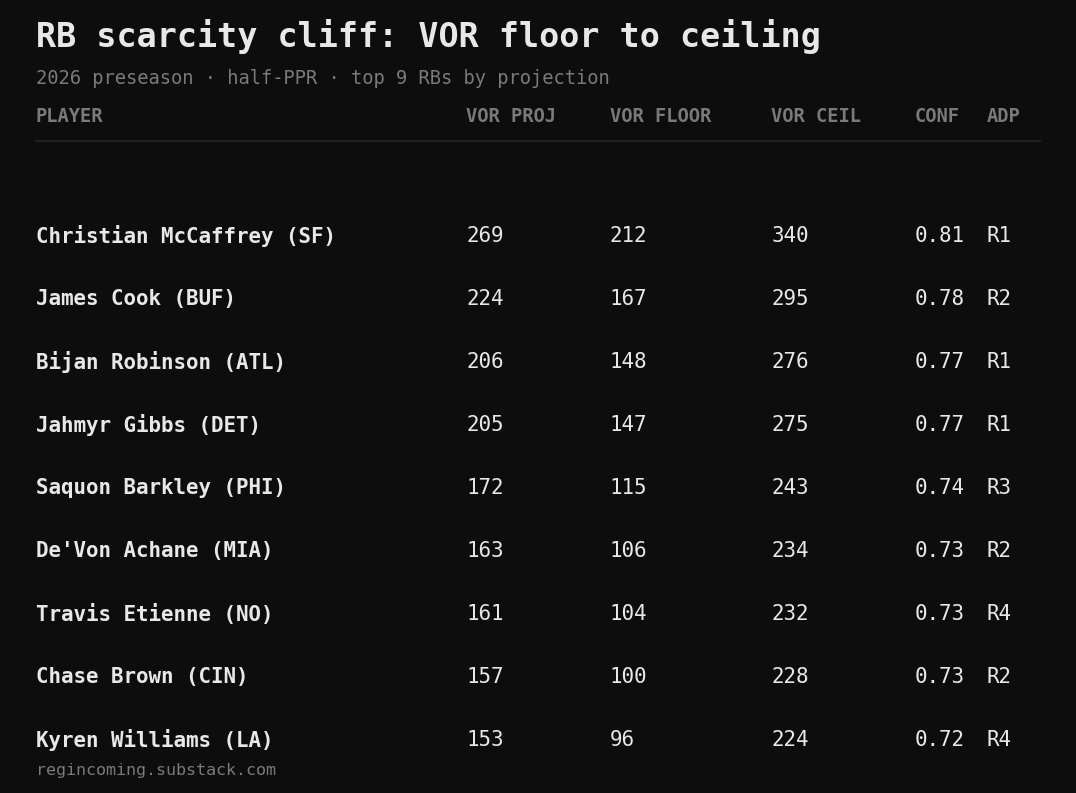
the specific RB map for 2026:
- RB1 Christian McCaffrey (SF): VOR 269, floor 212, confidence 0.81. R1.7 ADP. the model's highest-value player regardless of position.
- RB2 James Cook (BUF): VOR 224, floor 167, confidence 0.78. R2 ADP. best value gap in the top 12.
- RB3 Bijan Robinson (ATL): VOR 206, floor 148, confidence 0.77. R1.3 ADP.
- RB4 Jahmyr Gibbs (DET): VOR 205, floor 147, confidence 0.77. R1.5 ADP.
- RB5 Saquon Barkley (PHI): VOR 172, floor 115, confidence 0.74. R3.
- RB6 De'Von Achane (MIA): VOR 163, floor 106, confidence 0.73. R2.
- RB7 Travis Etienne (NO): VOR 161, floor 104, confidence 0.73. R4.
after RB7, you're in boom/bust territory. the floor thins out and confidence drops. you might be right about a late RB. but you're buying upside, not floor.
wide receiver
the WR pool is the opposite of RB.
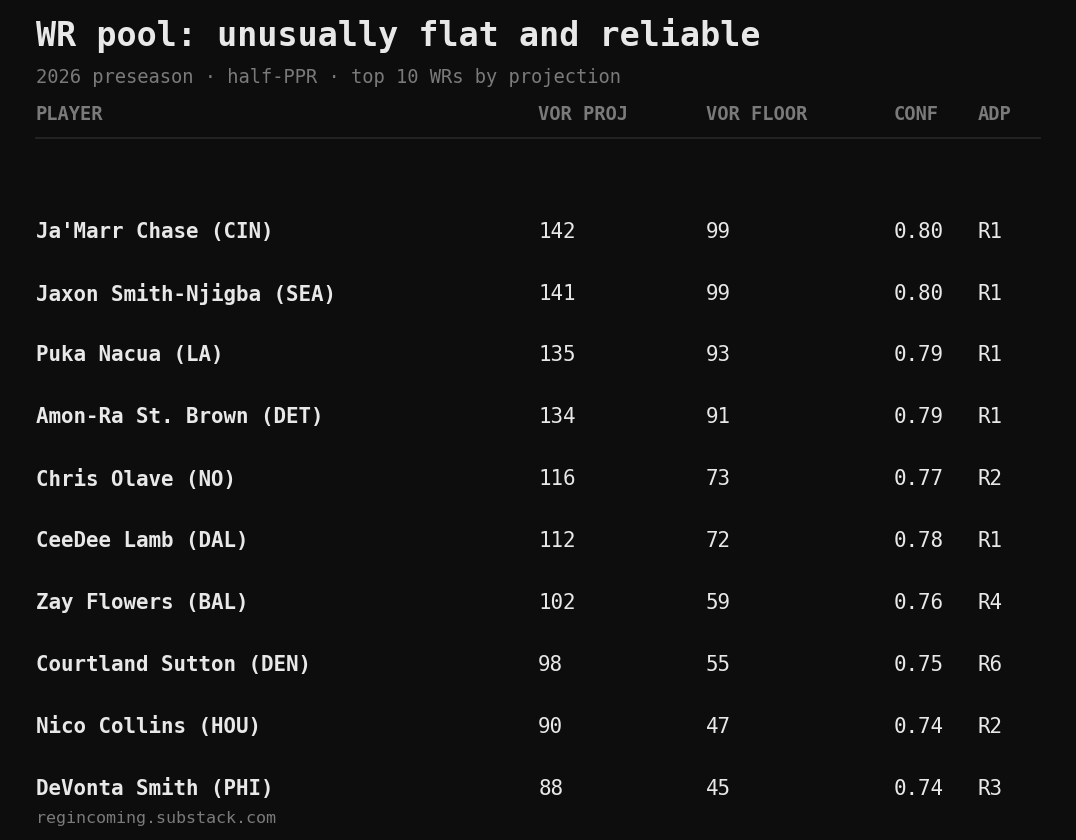
WR1 Ja'Marr Chase (VOR 142) and WR2 Jaxon Smith-Njigba (VOR 141) are essentially tied. the model sees them as interchangeable on a per-point basis. WR3 Puka Nacua (VOR 135) and WR4 Amon-Ra St. Brown (VOR 134) are also within noise of each other.
by WR6 (CeeDee Lamb, VOR 112), you've dropped only 30 points from WR1. for context, the drop from RB1 to RB6 is 106 points.
what this means: if you miss the elite RBs in rounds 1-3, the WR value in rounds 5-8 is nearly equivalent to what you'd get at WR in rounds 1-3. the market hasn't priced in how flat this position actually is. Courtland Sutton (WR8, R6 ADP, VOR 98) has a floor comparable to players going 4 rounds earlier.
tight end
the TE cliff is the sharpest in the model.
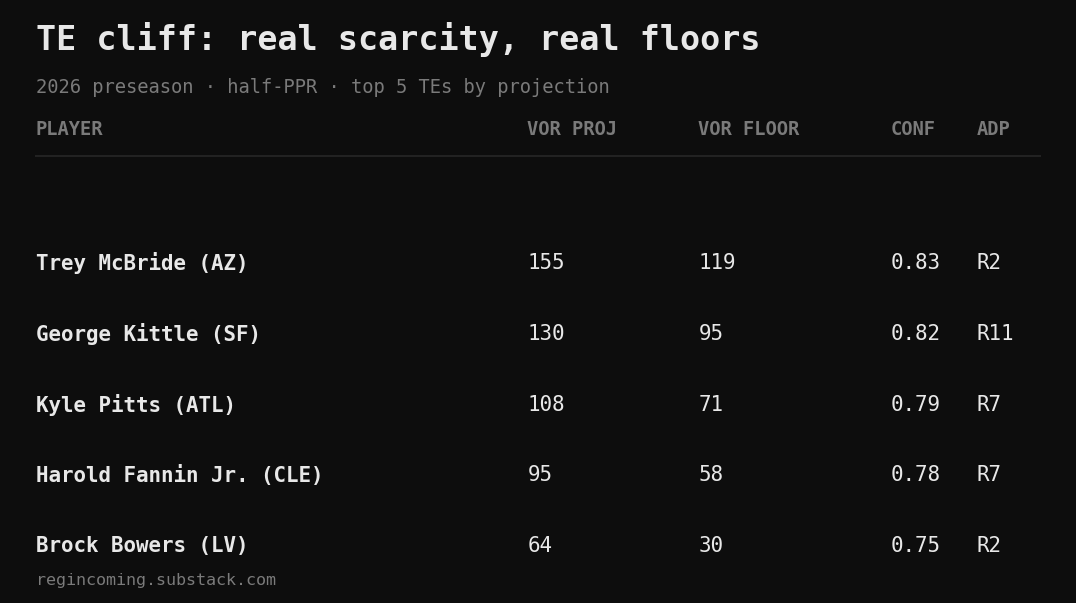
the top 3 TEs average 131 VOR. TE4-6 average 73 VOR. that's a 58-point average drop: steeper than even the RB cliff on a positional basis.
- TE1 Trey McBride (AZ): VOR 155, floor 119, confidence 0.83. R2.5 ADP.
- TE2 George Kittle (SF): VOR 130, floor 95, confidence 0.82. R11 ADP.
- TE3 Kyle Pitts (ATL): VOR 108, floor 71, confidence 0.79. R7 ADP.
Kittle at R11 is the biggest market inefficiency in the model. VOR 130, confidence 0.82. he's projected as a clear TE1b, and the market is pricing him as a late-round dart. if you go Late QB and defer on TE in the early rounds, Kittle in round 11 is the pick the model keeps returning to.
quarterback
the QB market has overcorrected for streaming. QB1 Trevor Lawrence (VOR 188, R7 ADP) and QB2 Josh Allen (VOR 144, R3 ADP) have a real gap. but QB3 Brock Purdy (VOR 126, floor 17) has a floor that's basically a replacement-level outcome. high ceiling, meaningful downside.
the late QB strategy works specifically because QB4-8 in the draft pool are available in rounds 7-10 with comparable median VOR to players going rounds earlier. you're not giving up much at the median. you're just accepting higher variance.
high-confidence floor plays
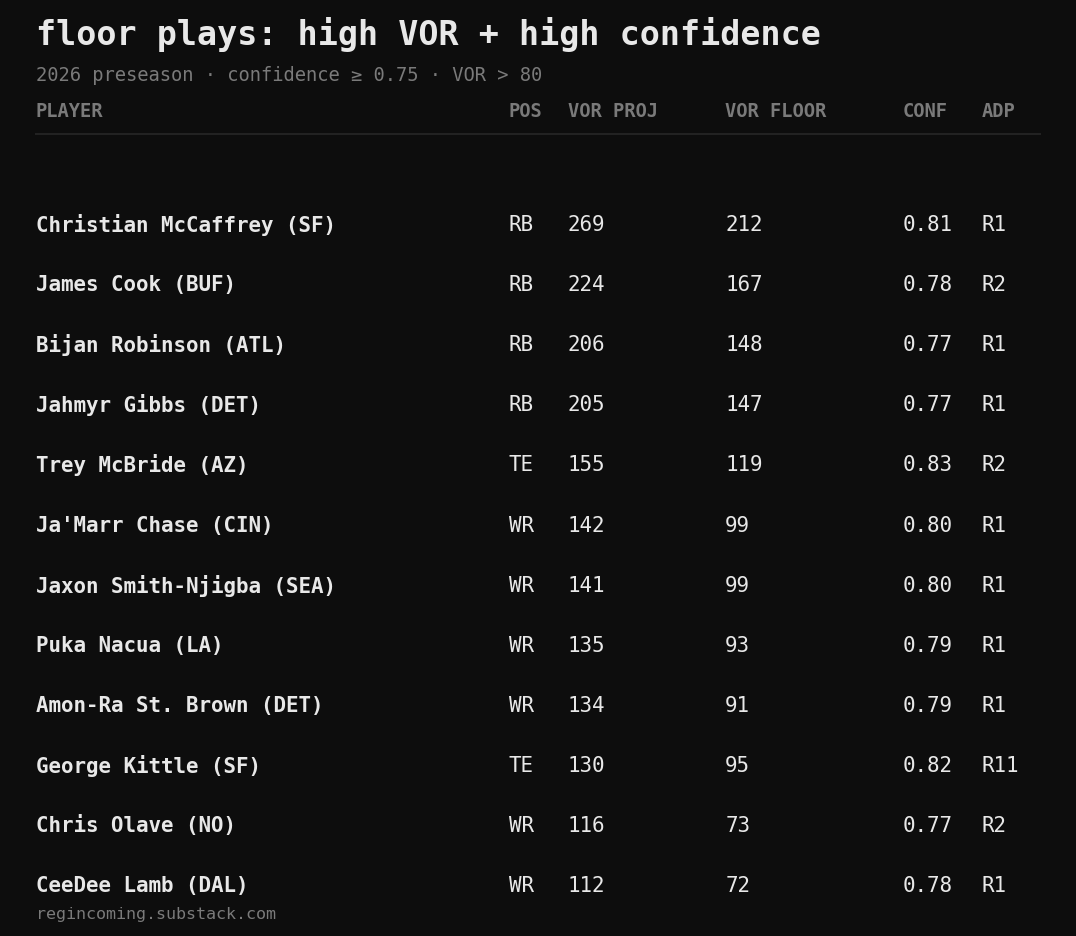
these are players where the model is projecting above-replacement and has high confidence in that projection. the floor alone is worth paying for. the list is dominated by elite RBs and the top WR tier. two entries stand out:
George Kittle (R11): VOR 130, floor 95, confidence 0.82. the most undervalued player in the model by ADP gap.
Chris Olave (R2, NO): VOR 116, floor 73, confidence 0.77. WR5 by projection, available as a second-round value. Travis Etienne's new team-mate, now reunited with an offense built for volume passing.
the boom/bust tier
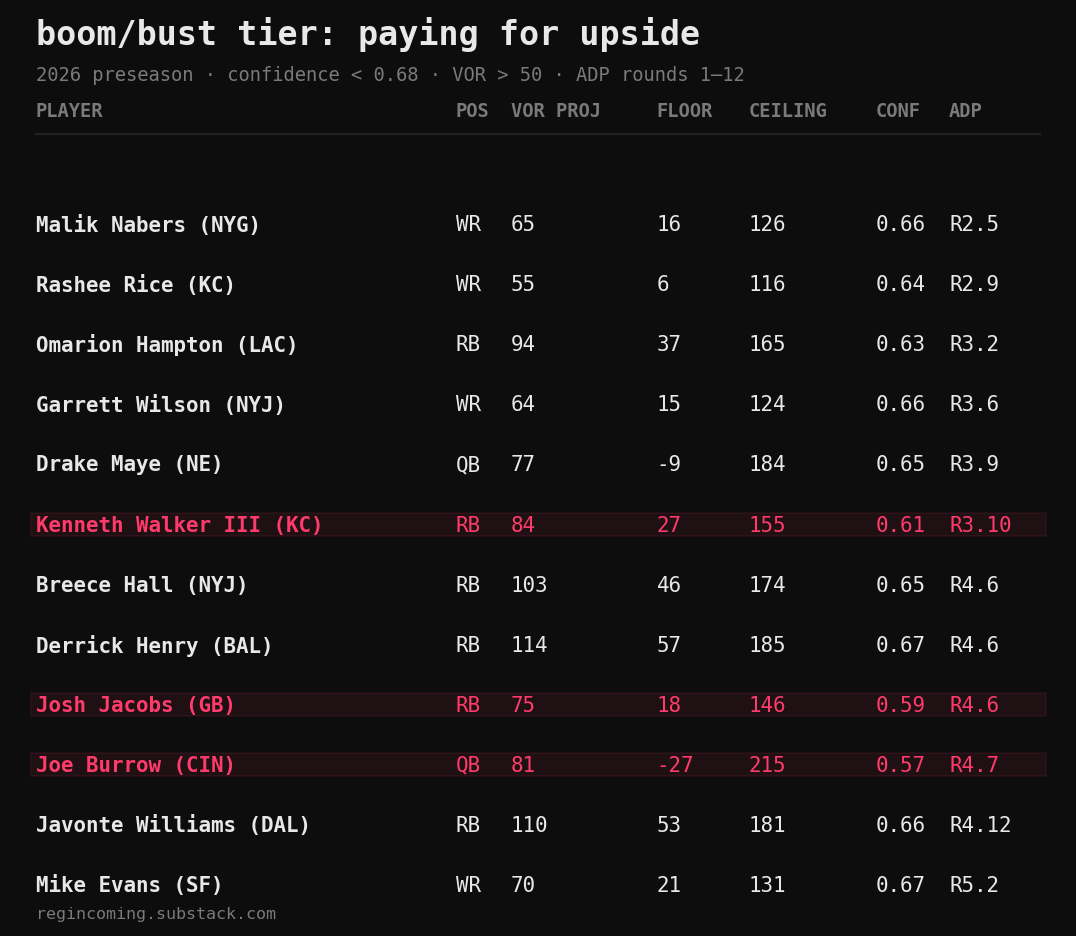
good VOR projection, low confidence. these are the picks where you're buying the ceiling, not the floor.
a few notes:
Derrick Henry (BAL): VOR 114, confidence 0.67. the floor is real: he's 32 with heavy usage. the ceiling is also real. the model isn't calling him a bust. it's calling him uncertain.
Breece Hall (NYJ): VOR 103, confidence 0.65. the NYJ situation is the confidence-killer. scheme uncertainty + injury history = wide range.
Javonte Williams (DAL): VOR 110, confidence 0.66. new team, new role, real upside. also a new team and a new role.
Omarion Hampton (LAC): VOR 94, confidence 0.63. the model's highest-ceiling rookie RB. also the highest-uncertainty rookie RB.
none of these are "avoid at all costs." they're "understand what you're buying."
strategy simulations: what actually wins
this is the piece most analysis skips. we ran eight distinct draft strategies through six historical seasons, letting each compete in a simulated 12-team half-PPR league.
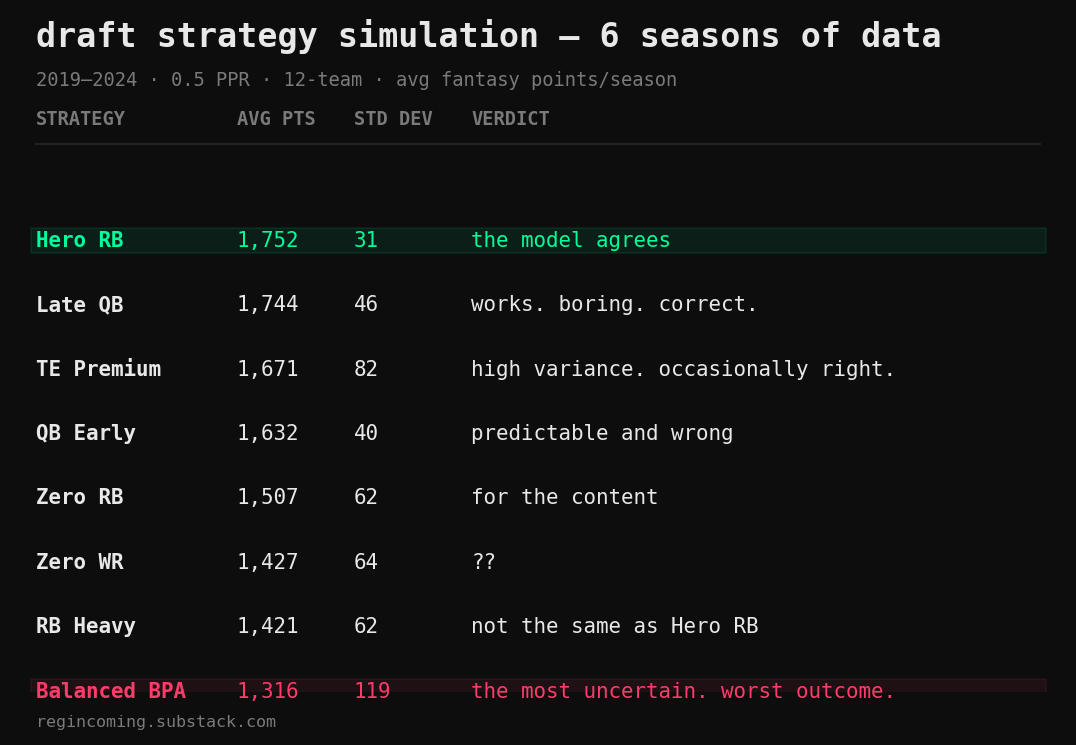
the results:
hero RB (secure two elite RBs in rounds 1-2): 1,752 average points per season, standard deviation of 31. the best average outcome and the most consistent.
late QB (QB in rounds 8-10): 1,744 points, std 46. essentially tied with hero RB in average. the small variance edge goes to hero RB.
TE premium (Trey McBride or Kittle in rounds 1-2): 1,671 points, std 82. works. adds significant variance for a modest downside vs hero RB.
QB early (Josh Allen in round 3 or earlier): 1,632 points, std 40. lower average than late QB. the model confirms what the data says: early QB is a structural mistake in this format.
zero RB: 1,507 points, std 62. the content strategy. it's not terrible. it loses to hero RB by 245 points per season.
balanced BPA (pure positional value, no constraints): 1,316 points, std 119. last place. highest variance. the most "logical" strategy produces the least reliable outcome. the model hates it.
the takeaway: the strategies that express a specific view on positional scarcity outperform the ones that try to be neutral. this year, the scarcity is in RB. draft that way.
the kicker section (required, brief)
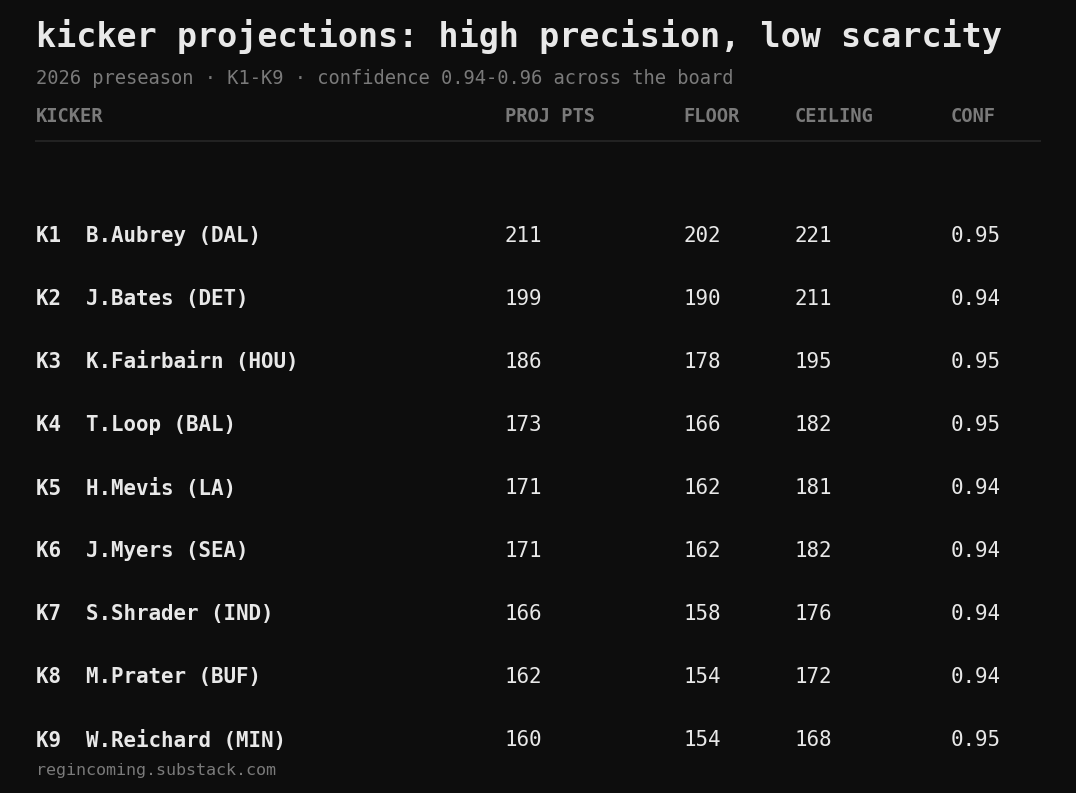
K1 Brandon Aubrey (DAL) projects to 211 points. K9 Will Reichard (MIN) projects to 160 points. the confidence on every one of these projections is 0.94-0.95. the model is very certain about kickers.
the 51-point gap between K1 and K9 across a 17-week season is real but not meaningful enough to justify drafting early. draft K in the last round. this is not controversial advice. the model agrees.
what to do with this
the 2026 positional map is unusually clear:
- RB scarcity is real: the top 8 RBs by VOR floor are worth paying for. below that, you're in boom/bust territory.
- WR flatness is an asset: you can wait on WR and still get WR1-tier outcomes. use that flexibility to load up at RB.
- TE has exactly three good picks: McBride (R2), Kittle (R11 value), Pitts (R7). after that, the floor drops sharply.
- QB late, every time: Trevor Lawrence (R7) is the best QB value. Josh Allen (R3) is the only QB worth taking early if you're in a rush. everyone else can wait.
- hero RB wins: six seasons of data say so. the model agrees. the math works out.
the Kittle thing is worth repeating: R11 ADP, VOR 130, confidence 0.82. if you're not taking a TE early, this is one of the clearest values in the model. don't let him fall to round 12.
come argue with us about zero RB in the comments.
[📥 grab the full preseason rankings sheet here: https://tinyurl.com/regincoming2026preseason]